
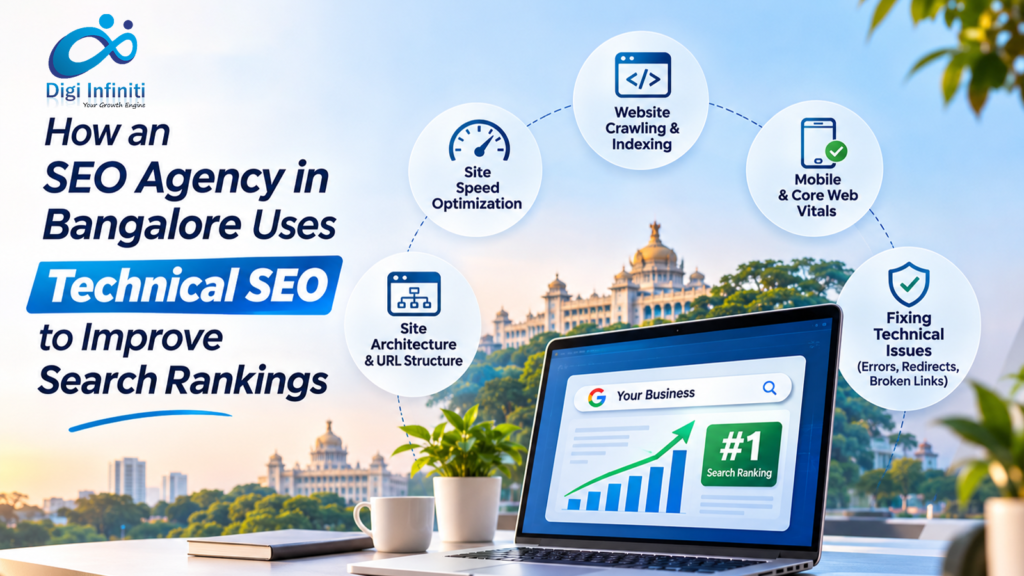
Ask a Bangalore business owner why a new service page isn’t showing on Google, and the cause is rarely the copy. It’s usually something nobody inspected: a noindex tag left over from development, a sitemap pointing at dead URLs, or a template that takes six seconds to appear on a mid-range phone. Technical SEO is the discipline of hunting down those faults.
A capable SEO agency in Bangalore treats this as the groundwork for everything else, because content and links can only perform when search engines can reach and make sense of a site. Digi Infiniti, a digital marketing agency in Bangalore, works in the same order: diagnose first, then build.
What follows is a walkthrough of that process: what gets checked, how fixes are prioritised, and how results should be judged.
What Is Technical SEO and Why Does It Matter?
Think of technical SEO as a website’s plumbing and wiring. Visitors never see it, yet it decides whether Google can discover a page, process its code and file it in the index. It spans site architecture, server responses, loading performance, mobile rendering, structured data and security settings.
Two ideas sit at the centre. Crawlability asks whether a bot can get to a URL and follow the links on it. Indexability asks whether Google is allowed, and willing, to keep that URL in its database after fetching it. A page can pass the first test and fail the second, for instance when a canonical tag nominates a different address as the preferred version.
The damage from getting this wrong is rarely a sudden crash. It’s quieter: a product category never appears in results, a high-value service page gets lost deep in the menu, a layout jumps under a visitor’s thumb. Each one chips away at organic performance.
How an SEO Agency in Bangalore Conducts a Technical SEO Audit
A serious SEO agency in Bangalore builds an audit from two data sources: a full crawl of the site and the reports Google provides through Search Console. The overlaps and gaps between them show where the problems live.
- Crawl and error detection: Desktop crawlers such as Screaming Frog or Sitebulb walk the site as a bot would, logging broken links, missing titles, duplicate headings, thin pages and server errors.
- Google Search Console : The page indexing report explains why URLs were left out. “Duplicate without user-selected canonical” and “Soft 404” need very different repairs, so the reasons matter more than the totals.
- XML sitemap: The file should hold only live, canonical, indexable addresses. A sitemap stuffed with redirects or removed pages weakens the signal it is meant to give.
- Robots.txt: This file steers crawling; it doesn’t remove anything from the index. Blocking a URL there while also tagging it noindex is a classic self-inflicted wound, since Google can’t read a tag on a page it may not fetch. Leftover “block everything” rules from staging servers turn up more often than you’d expect.
- Canonicals and duplicates: Tracking parameters, www versus non-www, HTTP versus HTTPS and filtered listings can produce several addresses for one page. Canonical tags suggest the preferred version, but Google may overrule them when redirects and internal links say otherwise.
- Status codes and redirects: A single 301 is fine; chains and loops waste time for bots and people. Deleted pages should return a genuine 404 or 410, not a friendly error message served with a 200 code.
- Orphan pages: Cross-checking the crawl against the sitemap and analytics data reveals pages that nothing links to.
Improving Website Speed and Core Web Vitals
Core Web Vitals are three user-experience measurements Google collects from real visits and judges at the 75th percentile:
- LCP (Largest Contentful Paint): how long the biggest visible element takes to Under 2.5 seconds is considered good.
- INP (Interaction to Next Paint): how quickly the page responds to taps, clicks and key presses across a visit. 200 milliseconds or less is good. It replaced First Input Delay in
- CLS (Cumulative Layout Shift): how much content moves A score of 0.1 or below is good.
Practical fixes usually involve:
- Resizing and compressing images, and serving WebP or AVIF versions
- Trimming, deferring or splitting JavaScript, the main cause of sluggish INP
- Removing unused CSS
- Setting cache headers, putting static files on a CDN and cutting server response time
- Reserving fixed space for images, banners and embeds so nothing pushes text around
A good SEO agency in Bangalore tests on mid-range Android phones over ordinary mobile networks, because that is closer to the real audience than a fast office laptop.
Keep expectations honest, though. Passing these thresholds improves usability and counts as one input among many. It doesn’t buy a ranking jump, and a quick page with weak content still
loses to a stronger answer. For companies about to rebuild, website development services that build speed and SEO into the brief avoid costly rework later.
Crawlability, Indexability, and Website Architecture
Architecture decides how efficiently both visitors and bots move through a site.
- Link depth Priority pages should sit a few clicks from the homepage. A page five levels down looks unimportant and gets revisited rarely.
- URL structure Short, readable, stable addresses are easier to maintain than parameter-heavy ones. If one must change, redirect it.
- Navigation Menus, breadcrumbs and sensible category trees show how pages relate to each other.
- Index controls Internal search results, thin tag pages and endless filter combinations usually deserve a noindex or canonical tag, so attention flows to pages worth ranking.
Crawl budget gets mentioned a lot, but Google has indicated it mostly concerns very large or fast-changing sites with hundreds of thousands of URLs. On a typical business website, runaway crawling points to duplicate or low-value URLs. A sensible SEO agency in Bangalore removes the duplication rather than treating crawl budget as the goal.
Structured Data and Search Appearance
Structured data labels a page’s content using the Schema.org vocabulary, so machines can read it with less guesswork. Google prefers JSON-LD, which sits in a script block and leaves the visible design untouched.
Common choices for business sites include Organization, LocalBusiness, BreadcrumbList, Article and Product markup, plus review markup where reviews genuinely appear on the page. Teams validate it with Google’s Rich Results Test and watch Search Console’s enhancement reports for errors.
Markup makes a page eligible for certain enhanced listings; it doesn’t promise them. Google has also scaled back some rich result types over the years, so check current documentation before planning around one.
Mobile SEO, HTTPS, and Technical Reliability
Google indexes primarily from the mobile version of a page, so whatever is missing there may be missing from the index. Compare mobile and desktop for content, internal links, structured data and meta tags, then check tap targets and text size.
Reliability checks that matter:
- HTTPS everywhere, with HTTP versions redirecting in one step
- Mixed content, such as an image or script loaded over HTTP on a secure page
- Broken links and recurring server errors, which waste crawl effort and visitor patience
- JavaScript-dependent content, verified through the URL Inspection tool to see what Googlebot actually renders
How the Best SEO Company in Bangalore Measures Technical SEO Performance
Anyone can claim to be the best SEO company in Bangalore. What separates providers is whether they can show what changed and why. A transparent SEO agency in Bangalore reports technical health and commercial outcomes separately.
- Technical health: indexed versus excluded URLs, Core Web Vitals status by device, crawl error and redirect trends, sitemap coverage, structured data validity
- Search visibility (Search Console): impressions, clicks, queries, average position and organic landing-page performance
- Business results (Google Analytics): conversion events such as form submissions, calls and purchases, and which organic leads turned out to be qualified
A tidy index is progress, not revenue. Rankings also shift because of competitors and algorithm updates, so judge results over months, not days. Be wary of anyone guaranteeing positions or leads.
Integrating Technical SEO with a Broader SEO Strategy
Technical fixes clear the road; they don’t supply the traffic. Sites also need content that serves search intent better than the pages ranking today, well-written titles and headings, internal links that point authority at priority pages, and backlinks earned through genuinely useful material. This is why many companies pick an SEO agency in Bangalore that handles the engineering and editorial sides together.
Why Businesses Consider Digi Infiniti for SEO Services in Bangalore
Digi Infiniti is a Bangalore-based agency offering SEO, Google Ads and PPC, social media marketing, local SEO and website development. Its SEO services for business growth include keyword research, on-page and off-page optimisation, and ongoing performance tracking.
Having these services in one place helps with coordination:
- Technical findings can feed straight into site builds and
- Content work benefits from clean architecture and dependable
- Performance marketing solutions can bring paid traffic while organic visibility builds, and fast landing pages help both channels.
- Social media marketing services support awareness and can send engaged visitors to well-structured pages.
When comparing any SEO agency in Bangalore or SEO company in Bangalore, ask for a sample audit, how issues are ranked by priority, and how progress is reported. The answers reveal more than any ranking claim.
Building a Technically Strong Website for Long-Term Search Visibility
Technical SEO is rarely glamorous, but it decides whether your best pages can be found, indexed and used comfortably on any device. The routine is simple: audit, fix what blocks crawling and indexing first, improve speed and stability, validate structured data, then keep monitoring, because sites change and new faults appear.